

Technology used to be something we operated with. But thanks to AI, it’s now something we operate in. It’s immersive, it’s alive. Interactions have moved from transactional to conversational. Responses aren’t merely displaying existing information; they’re creating new context and even new content.
Interaction has become more human-like. And in a world where communication between people and companies depends heavily on technology, this AI shift is nothing short of a game-changer for brands and marketing.
Cue in Arjan Kapteijns, former CEO of Saatchi & Saatchi Netherlands, whose recent Brandingmag article redefines Kevin Roberts’ concept of a Lovemark for an AI-infused world. A world in which earning love and respect is no longer exclusively directed at humans, but also at their digital agents. He calls them Agentic Lovemarks, offering marketeers a playbook for how to look at building brands in the future. The base remains the need to create emotional connection; it’s just that that connection is now orchestrated by machines.
Since psychology entered marketing in the early 20th century, experts have used emotions to connect brands with their consumers (and vice versa). What began as emotional persuasion in advertising evolved into a deeper understanding: a strong emotional connection to a brand drives long-term loyalty and repeat purchases.
But in order for humans to connect emotionally to a thing, these things needed to become more connectable. More human.
This is where archetypes come in. When Margaret Mark and Carol Pearson introduced the 12-brand archetype model in The Hero and the Outlaw 25 years ago, they transformed modern brand building. It gave marketers something tangible, a rational guide to irrational behavior.
Theirs is a human-inspired personality framework defining how a brand looks, speaks, and behaves with the intention of creating a holistic brand personality that consumers can experience, connect with, and fall in love with.
What functioned for decades as a model for building emotional connection won’t be sufficient to build Agentic Lovemarks.
The traditional framework won’t be insufficient because it’s no longer true, but rather because it isn’t distinct and instructive enough for the agentic economy. Where before we had control over how a brand is experienced through technology—where we were able to manually shape and steer it based on the brand’s personality—we’re now being directly and indirectly forced to give that control to an AI.
Given that agents will autonomously operate and communicate on behalf of people and brands alike, and the increasingly conversational and individual nature of humans-to-brands-via-machines relationships, brands face two main requirements for translating their personalities into the future.
- Brand personalities must reflect true human behavior.
Humans are more complex when behaving and communicating within a 1-on-1 conversation, something an archetype cannot describe. The 12-brand archetype model remains relevant for informing an overall basic direction, but it won’t be enough to inform a human-like interaction created by technology. It leaves too much room for interpretation. Allowing the machine to interpret something out of a mere archetype is like generating a random logo every time someone searches for your brand. Their experience would be different each and every time.
- Brand personalities must be legible to machines.
This is where concept becomes truth, and brands become operational. Thomas Marzano, former brand leader of Philips and ASML, states in his future-defining manifesto Brand Constitutions that in an agentic economy, brands need to be both legible to AI in order to be recognized and recommended by the machine and loveable by humans in order to be relevant in their decision making. He describes this as the Legible-Lovable Law.
This takes a structural and almost technical approach to underlining the future relevance of brands, not as the end of emotional connections, but as their technical reinforcement. Only if the brand can be read, understood, and rendered by the AI can it become “branded AI.” It offers instruction on how the AI should adjust its verbal tone, vocabulary, voice, and response behavior. Otherwise, the interaction would remain generic and sorely lacking any kind of brand-relevant emotional connection.
For this to effectively occur, however, we need a new model for defining a brand’s personality. More detailed and catered. A tech-savvy one that’s less interpretative. That model is the PRISM model.
Introducing the PRISM model
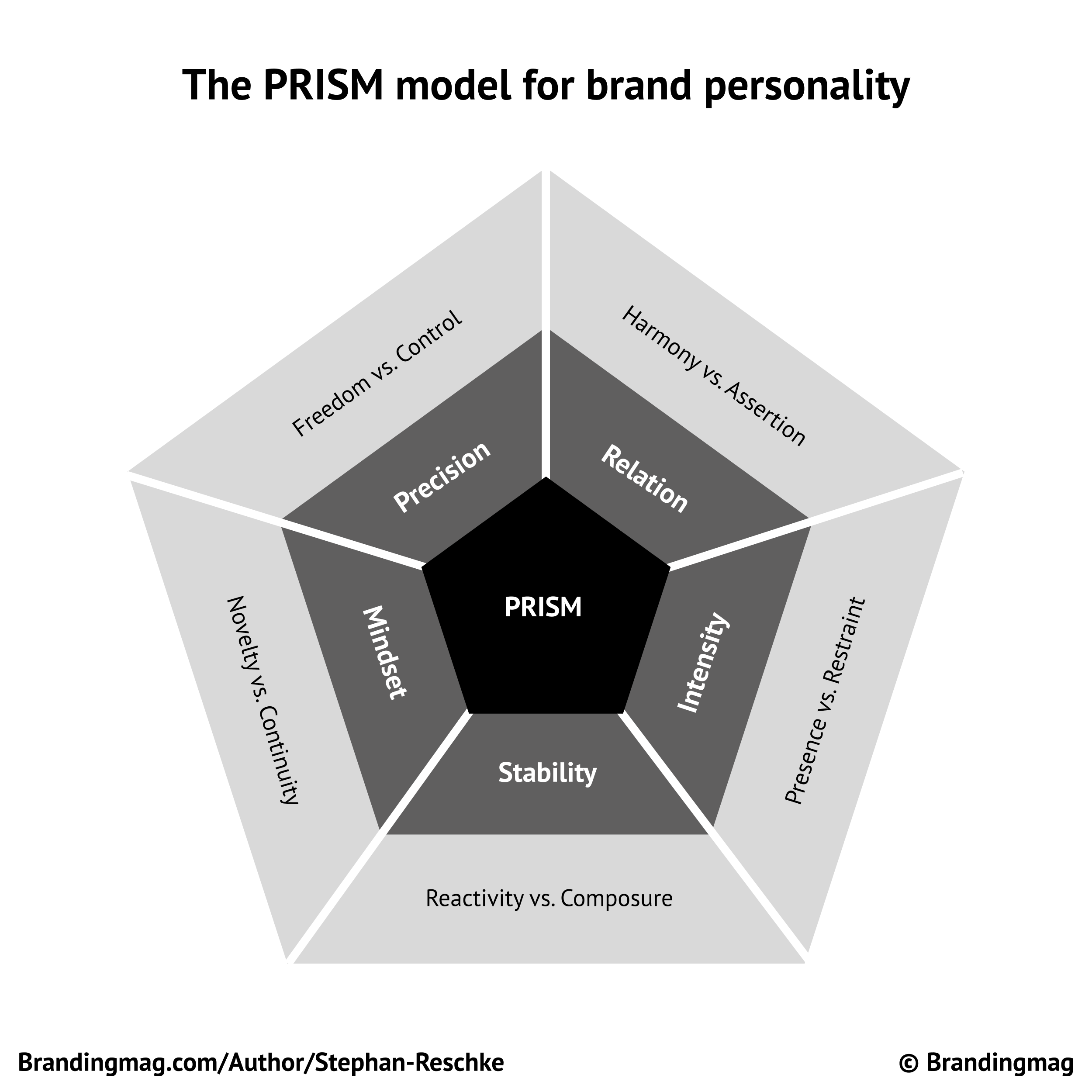
The PRISM model is based on the widely accepted human psychology model OCEAN (or the “Big Five”), adjusted for brands. It classifies the personality through five core domains:
- Precision—How self-confident, structured, and dependable are we?
- Relation—How empathetic, supportive, and cooperative are we?
- Intensity—How outgoing, energetic, and attention-seeking are we?
- Stability—How calm, controlled, and balanced are we?
- Mindset—How curious, exploratory, and future-oriented are we?
It’s not an exclusive system like the archetypes, but rather a comprehensive compilation of attitudes, thinking, and mindset that makes every human (and in this case, every brand) distinct and unique.
Each of these domains consists of six defining characteristics. These characteristics are further evaluated on a scale, giving the PRISM model the nuances it needs to cover the complexity of human personalities.
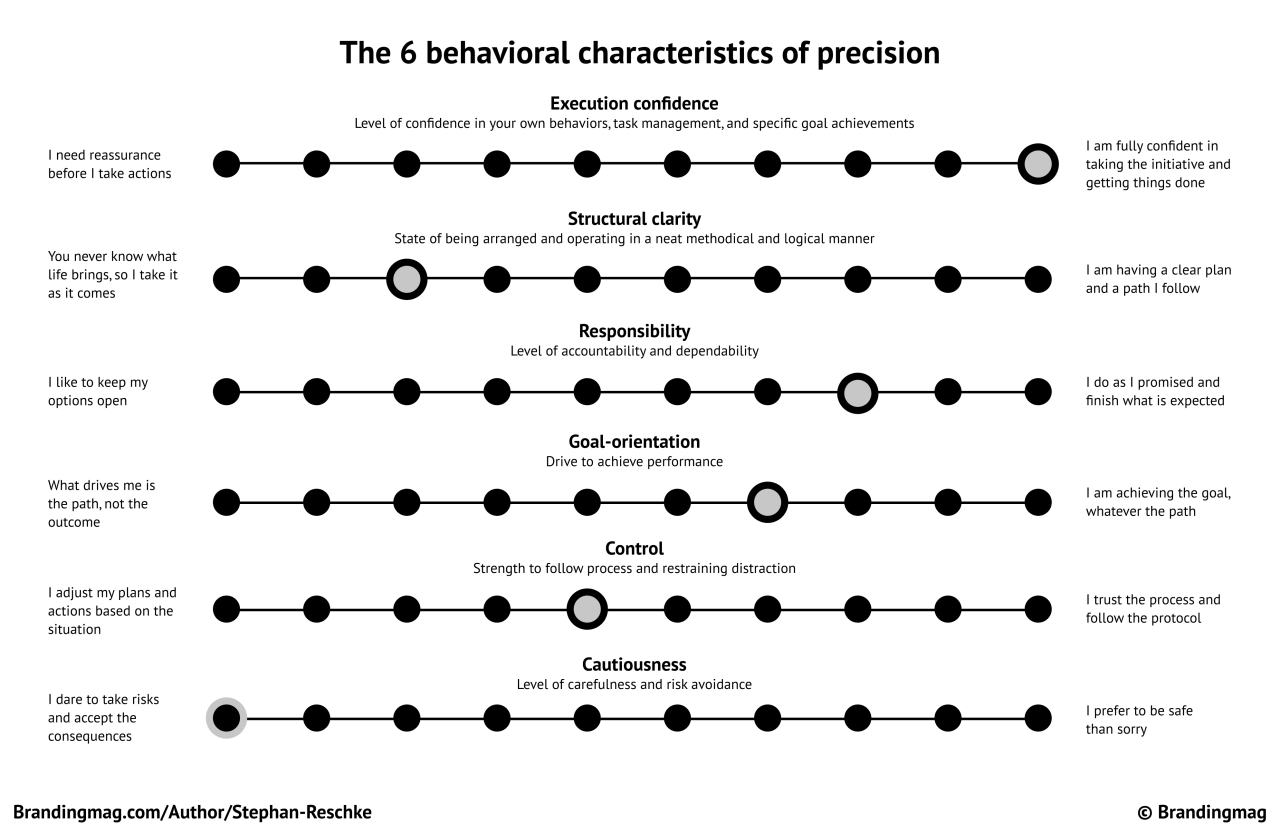
The model’s purpose is to define personality in the aspect of mindset, communication, and behavior, which makes it an ideal framework for brands looking to inform more human-like interactions. Its technical setup and comprehensive definition provides brands with a legible personality guideline for AI agents to read, understand, and act on, thereby setting the foundation for creating emotional connections within human-to-brand-via-machine interactions.
In other words, the PRISM model provides a fundamental layer of the “Experience Engine” that Marzano describes in his Brand Constitution—the concept of an individual, real-time, on-demand brand experience created and orchestrated by AI. And it’s a crucial puzzle piece for brands to become Agentic Lovemarks.
Brand language instead of brand campaign
With our control of and interaction with technology becoming increasingly voice-driven—more hearing and speaking, and less seeing—language (in the broader sense) is all of a sudden the primary touchpoint between humans and brands.
Brands need to put extra focus on developing a clear framework for how they show up in this environment—the vocabulary and grammar they use, the tone they communicate with, and the voice they have.
LLMs don’t read campaigns. They read data, understand context, and create content, resulting in the indispensable relevance of brand language in building connections.
This is where the PRISM model plays a crucial role. It’s a lens through which a brand can manifest its digital personality, thereby setting the foundation for branded language. It provides a clear verbal and behavioral guideline that doesn’t have to live in a PDF, but rather in system prompts intended for large language models (LLMs).
At that point, the brand can:
- Instruct generative pre-trained transformers (GPTs)—which are a type of LLM—on how to review, rewrite, and create text.
- Have branded AI agents interact as branded humans would.
- Inform customer-facing chatbots to speak in the right brand language for a more distinct and memorable experience.
But even more so, the model’s results inform the construction of a digital soul (if you will) that’s implemented in a brand’s web infrastructure for LLMs to read, understand, and render.
Keep on building, exploring, and exchanging
The future provides excitement and anxiety simultaneously. But, as we all know, anxiety mainly stems from not knowing what to expect.
The best way to meet this uncertainty is by facing it straight on, through exploration, questions, trying, learning, and above all, exchange. The PRISM model provides another framework for comprehending and engaging with that uncertain future—a future in which humans, agentic AI, and brands engage on a deep and profoundly complex level.
The conversations have started. If you haven’t yet, it’s time to dive in.
Cover image: Luste Art Group